




NIO Study Links Climate Change to Increased Underwater Volcanism
NIO study: Climate change linked to increased underwater volcanic activity
 The Times Of India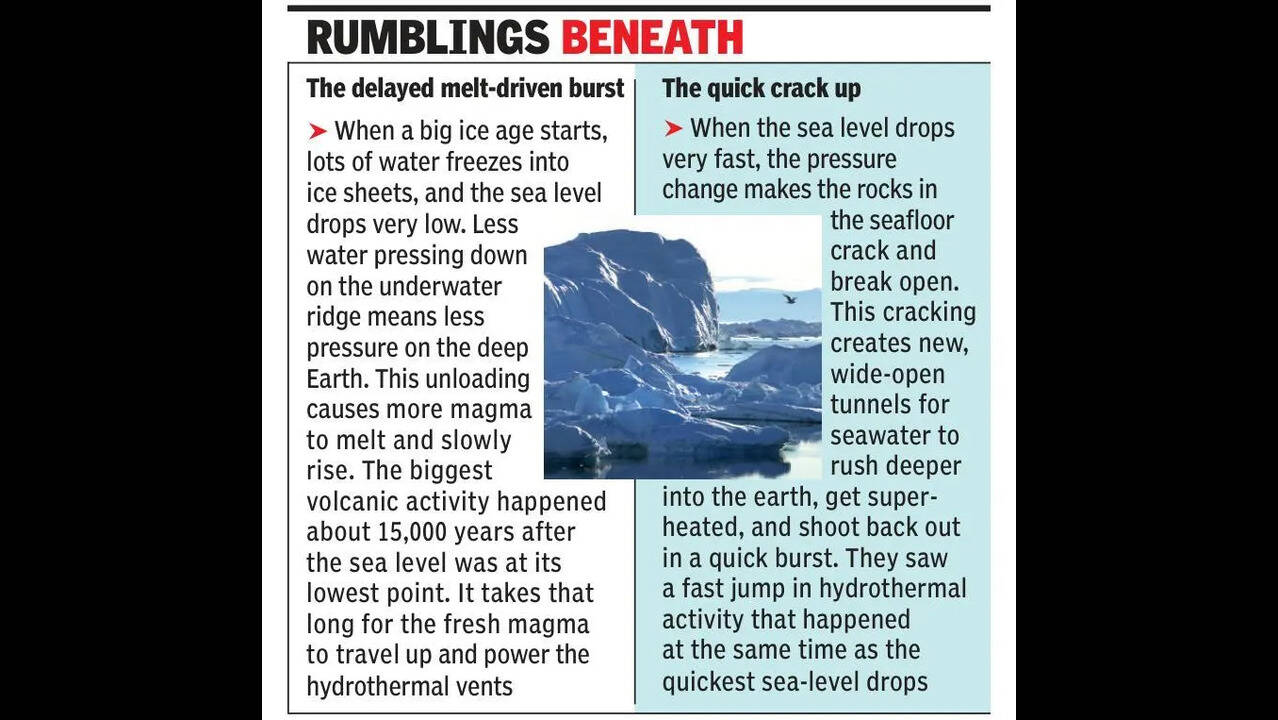
Image: The Times Of India
A study by scientists from the National Institute of Oceanography (CSIR-NIO) in Goa, India, reveals that climate change has influenced underwater volcanic activity along mid-ocean ridges, particularly the Carlsberg Ridge in the Indian Ocean. The research indicates that fluctuations in sea levels during ice ages have a significant impact on hydrothermal systems, potentially affecting ocean chemistry and marine life.
- 01Climate change is linked to increased underwater volcanic activity along mid-ocean ridges.
- 02The study focused on the Carlsberg Ridge in the Indian Ocean, a slow-spreading ridge.
- 03Fluctuations in sea levels during glacial periods influence hydrothermal systems.
- 04The research highlights the role of underwater vents in dispersing essential trace metals into the ocean.
- 05Hydrothermal systems act as archives of past climate changes and impact deep ocean chemistry.
Advertisement
In-Article Ad
Scientists from the National Institute of Oceanography (CSIR-NIO) in Goa, India, have conducted a study revealing that climate change significantly influences underwater volcanic activity along mid-ocean ridges, specifically the Carlsberg Ridge in the Indian Ocean. The research indicates that fluctuations in sea levels during glacial periods have a direct impact on hydrothermal systems, which are sensitive to changes in global climate. By analyzing mud and rock samples, researchers found rust-colored Fe-Mn oxyhydroxides that indicate volcanic activity over the past 49,000 years. The study shows that lower sea levels during glacial periods reduced hydrostatic pressure, leading to increased underwater volcanism and the release of heat and carbon dioxide. These hydrothermal systems are crucial for dispersing trace metals like cobalt and nickel into the deep ocean, potentially influencing marine life and ocean chemistry. The findings suggest that these systems serve as important archives of past climate changes and play a role in modulating trace metal flux across glacial-interglacial cycles.
Advertisement
In-Article Ad
The study highlights the importance of underwater volcanic activity in influencing ocean chemistry, which could have implications for marine ecosystems and fisheries in the region.
Advertisement
In-Article Ad
Reader Poll
How concerned are you about the impacts of climate change on ocean ecosystems?
Connecting to poll...
Read the original article
Visit the source for the complete story.