




The Journey of Iceberg A-23A: A 40-Year Saga Ends in Fragmentation
End of a giant: Trillion-tonne iceberg, twice the size of Greater London, breaks just before 40th birthday
 The Economic Times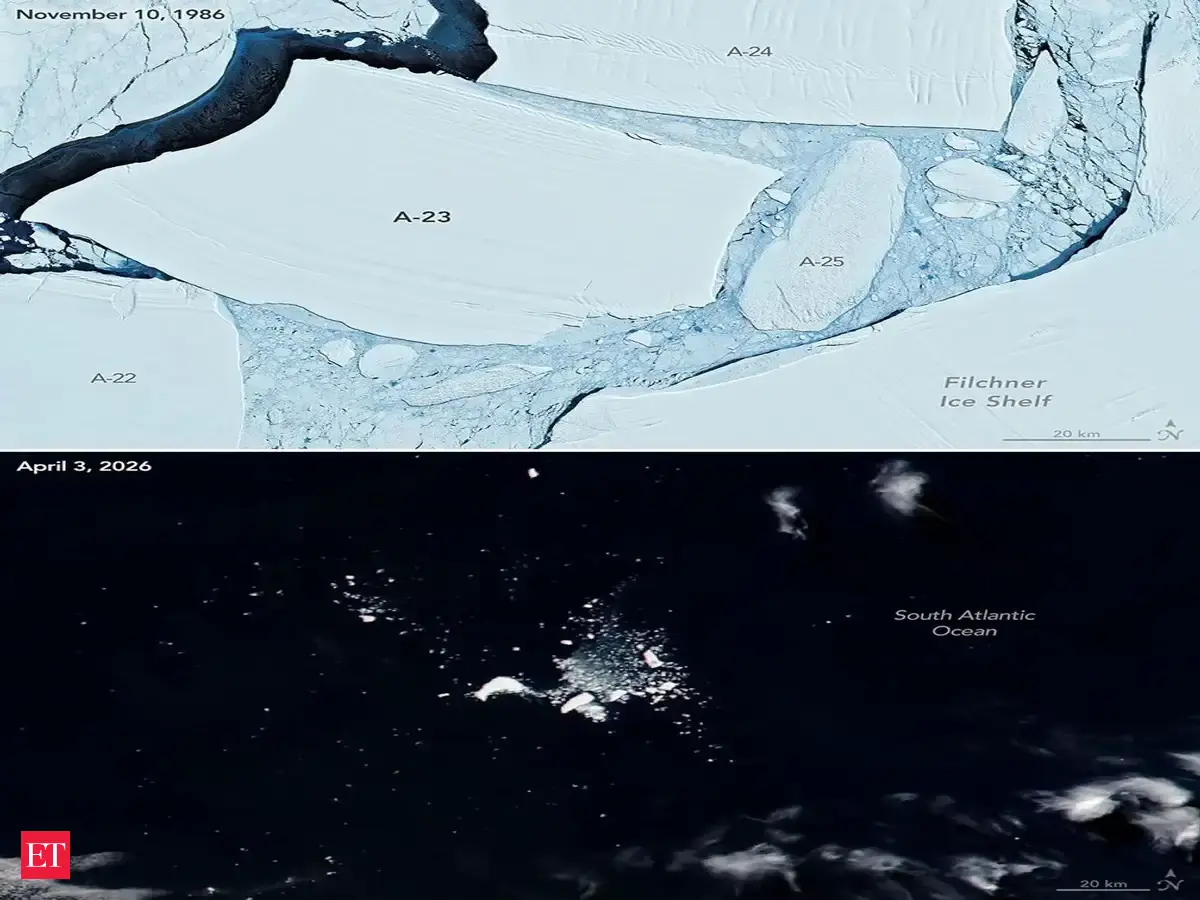
Image: The Economic Times
The world's largest iceberg, A-23A, has disintegrated just months before its 40th anniversary after drifting thousands of miles across the Southern Ocean. Once weighing nearly a trillion tonnes and covering over 1,540 square miles, its collapse marks the end of a significant chapter in polar science.
- 01A-23A was the world's largest iceberg, breaking apart just before its 40th anniversary.
- 02It drifted over 2,000 miles after breaking free from Antarctica's Filchner Ice Shelf in 1986.
- 03The iceberg contributed to marine ecosystems by fueling phytoplankton blooms with its iron-rich meltwater.
- 04A-23A's final months were marked by rapid melting and fragmentation as it approached South Georgia.
- 05Its journey provides valuable insights into the effects of climate change on polar ice.
Advertisement
In-Article Ad
The colossal iceberg A-23A, once weighing nearly a trillion tonnes and covering over 1,540 square miles, has finally disintegrated after nearly 40 years of existence. Originating from Antarctica's Filchner Ice Shelf in 1986, A-23A remained largely unchanged for over three decades before breaking free in 2020. Its journey across the Southern Ocean captured the attention of scientists globally as it traveled more than 2,000 miles. During its final months, warmer waters accelerated its melting, leading to fragmentation as it drifted near South Georgia, a British territory known for its wildlife. By April 3, 2025, only tiny fragments of the once-mighty iceberg remained. A-23A's significance lies not only in its size but also in its environmental impact, as its meltwater contributed to local marine ecosystems while simultaneously leading to its own destruction. Dr. Jan Lieser, who tracked A-23A, noted the iceberg's final days were shrouded in clouds, symbolizing its quiet end.
Advertisement
In-Article Ad
The disintegration of A-23A may affect local marine ecosystems, as its meltwater previously supported phytoplankton blooms that are crucial for the food chain.
Advertisement
In-Article Ad
Reader Poll
What do you think is the most important action to combat climate change?
Connecting to poll...
More about NASA
NASA revela imagens impressionantes da Lua durante a missão Artemis II
G1 - O Portal • Apr 14, 2026

Space Worms Launched to Study Health Challenges for Future Human Spaceflight
Popular Science • Apr 14, 2026

Intuitive Machines Stock Reaches 52-Week High Following Artemis II Mission Success
Benzinga • Apr 13, 2026
Read the original article
Visit the source for the complete story.