
Iran's President Appeals for Dialogue Amid Diminished Authority
Iran’s president appeals to Americans − but does his office still hold any real power?
 The Conversation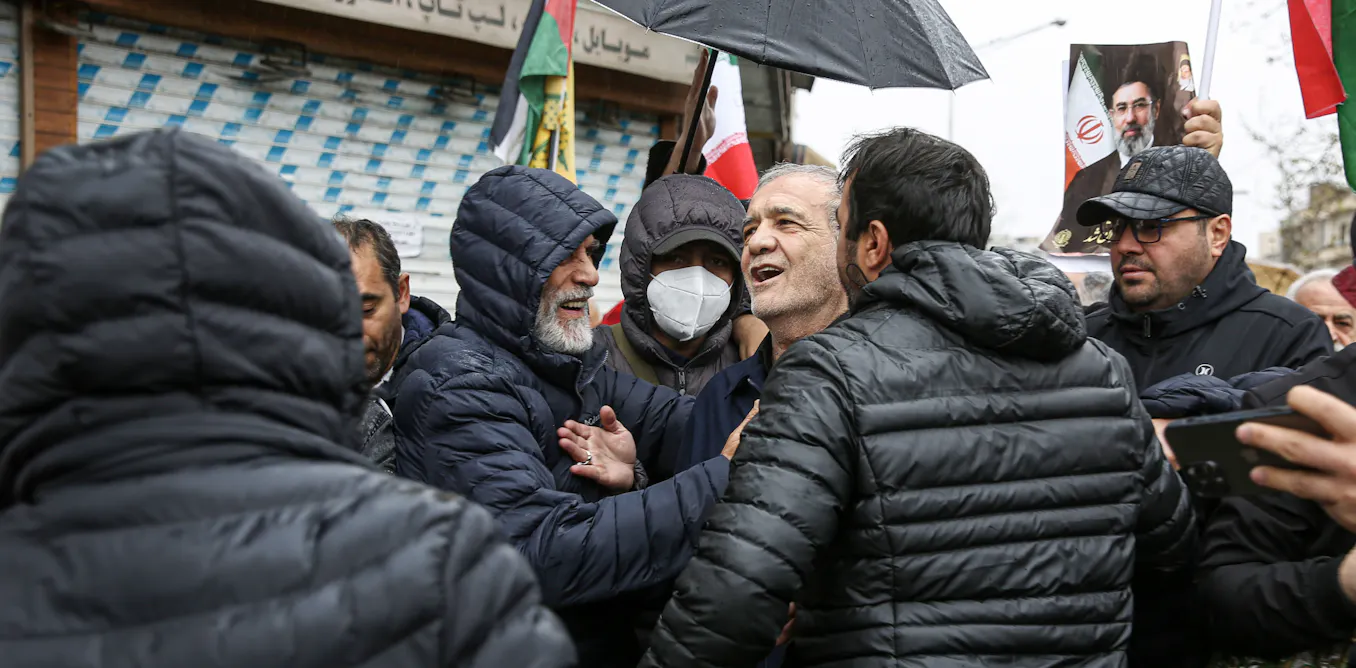
Image: The Conversation
Iranian President Masoud Pezeshkian's open letter to Americans on April 1, 2026, calls for understanding amid rising tensions. However, his authority is questioned as Iran's political structure increasingly resembles a centralized dictatorship, sidelining the presidency in favor of the supreme leader's dominance.
- 01Masoud Pezeshkian's open letter aimed at fostering dialogue with Americans.
- 02The Iranian presidency has seen its power diminish significantly over the years.
- 03The role of the supreme leader has overshadowed the presidency, raising concerns about political legitimacy.
- 04Voter turnout in Iran has declined, reflecting public disillusionment with the electoral process.
- 05The ongoing war and political repression further weaken the presidency's influence.
Advertisement
In-Article Ad
On April 1, 2026, Iranian President Masoud Pezeshkian penned an open letter to the American public, urging them to see beyond misinformation about Iran amidst escalating tensions. Despite this significant outreach, Pezeshkian's authority is under scrutiny as the political landscape in Iran increasingly favors the supreme leader, currently Ali Khamenei's son, Mojtaba Khamenei, following Khamenei's death. This shift has led to the presidency being marginalized, with the office losing its former power to shape public policy and discourse. The 2009 contested election of Mahmoud Ahmadinejad marked a turning point, leading to the consolidation of power around the supreme leader and a decline in public trust in the electoral process. Voter turnout dropped to just 39.9% in the 2024 elections, indicating widespread disillusionment. As Pezeshkian seeks diplomacy, questions arise about the relevance of his office in Iran's current political climate.
Advertisement
In-Article Ad
The diminishing role of the presidency affects political representation and public engagement in Iran, leading to a more centralized and authoritarian governance structure.
Advertisement
In-Article Ad
Reader Poll
Do you believe the Iranian presidency still holds significant power?
Connecting to poll...
Read the original article
Visit the source for the complete story.