




New Study Reveals Universal Patterns in Language Structure Across 1,700 Languages
Study of 1,700 languages uncovers hidden rules shaping how we speak
 The Indian Express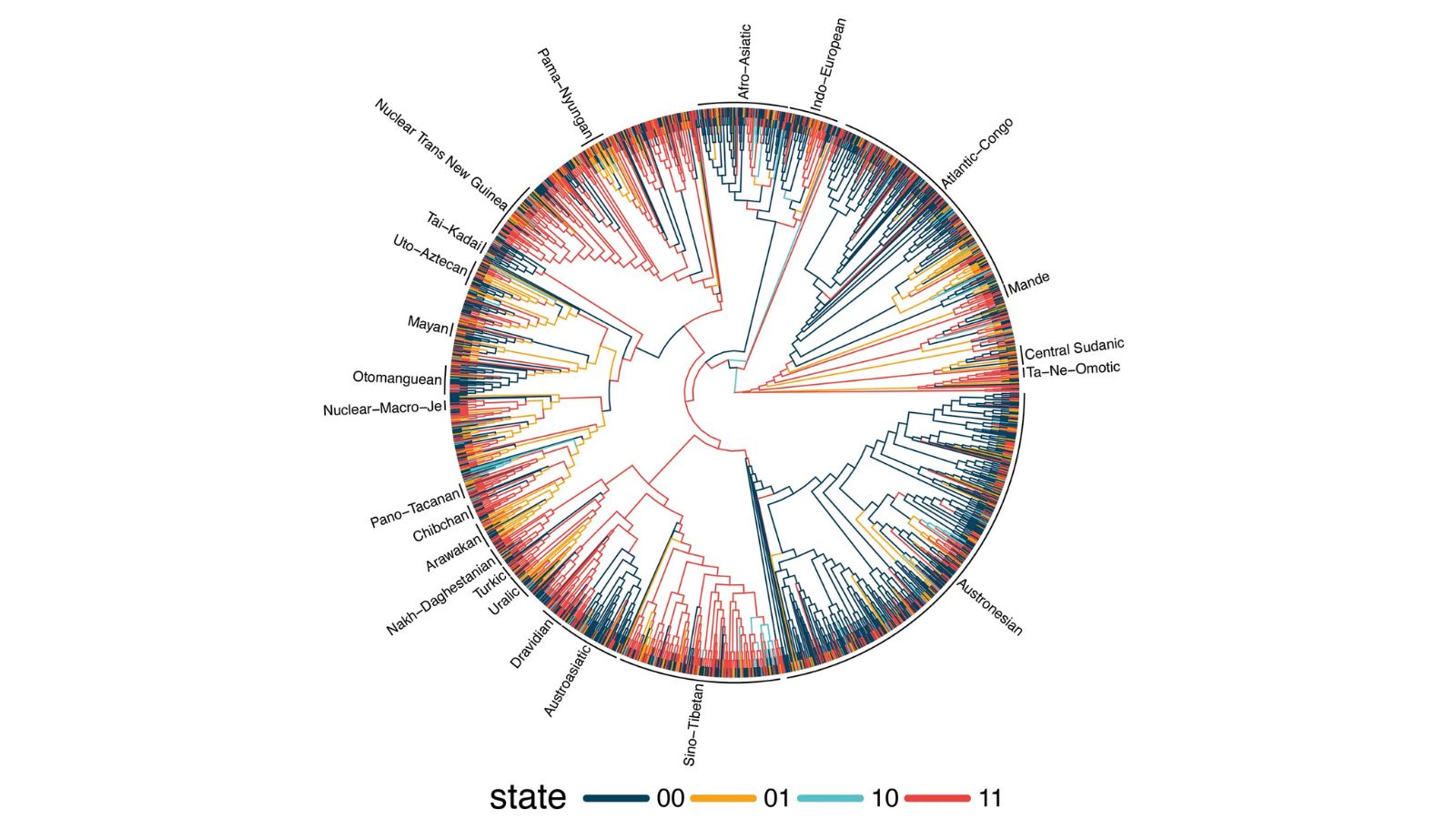
Image: The Indian Express
A recent study led by researchers from Saarland University and the Max Planck Institute analyzed over 1,700 languages, uncovering common grammatical structures influenced by human psychology. This research suggests that despite linguistic diversity, languages evolve in predictable patterns, challenging traditional views in linguistics.
- 01The study analyzed over 1,700 languages to identify universal grammatical structures.
- 02Researchers used advanced Bayesian spatio-phylogenetic analysis to ensure unbiased results.
- 03Nearly one-third of proposed linguistic universals were statistically supported.
- 04Languages exhibit recurring patterns in structure, such as word order.
- 05Cognitive processes and communicative needs may drive language evolution.
Advertisement
In-Article Ad
A groundbreaking study involving over 1,700 languages was conducted by an international team led by Annemarie Verkerk from Saarland University and Russell D. Gray from the Max Planck Institute for Evolutionary Anthropology in Germany. Utilizing the Grambank data set, which contains extensive grammatical features, researchers explored 191 linguistic universal candidates. Their findings reveal that many languages share similar structures, challenging the notion that language evolution is random. The team employed Bayesian spatio-phylogenetic analysis to account for both common ancestry and geographic origin, yielding unbiased results. They discovered that nearly one-third of linguistic universals are statistically supported, indicating that despite linguistic diversity, languages evolve through discernible patterns rather than chaos. This suggests that shared cognitive processes and communicative needs may influence how languages develop. The study highlights recurring patterns, such as word order and grammatical relationships, across unrelated language families and regions, underscoring the universal characteristics that shape human communication.
Advertisement
In-Article Ad
Advertisement
In-Article Ad
Reader Poll
Do you believe there are universal rules that govern all languages?
Connecting to poll...
Read the original article
Visit the source for the complete story.